Empirical Machine Learning
Faculty
- Courant Institute School of Mathematics, Computing, and Data Science: Samuel Bowman, Kyunghyun Cho, Eunsol Choi, Ernest Davis, Rob Fergus, David Fouhey, He He, Yann LeCun, Daniel Neill, Lerrel Pinto, Jean Ponce, Mengye Ren, Pratyusha Sharma (2026), Saining Xie, Sai Zhang;
- Faculty of Arts and Science: Samuel Bowman, Weiji Ma;
- Robert F. Wagner Graduate School of Public Service: Daniel Neill;
- NYU Abu Dhabi: Keith Ross, Julian Togelius;
- Tandon School of Engineering: David Fouhey, Chinmay Hegde, Keith Ross, Julian Togelius, Eugene Vinitsky, Sai Zhang;
-
Computational Intelligence, Learning, Vision, and Robotics (CILVR)
The CILVR Lab (Computational Intelligence, Learning, Vision, and Robotics) regroups faculty members, research scientists, postdocs, and students working on AI, machine learning, and a wide variety of applications, notably computer perception, natural language understanding, robotics, and healthcare.
-
Control and Network Lab
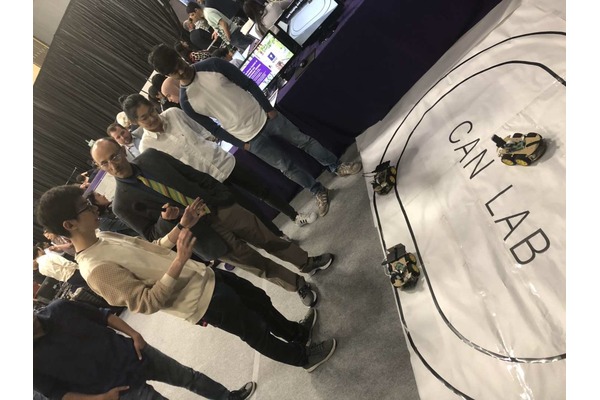
Research activities in the Control and Network (CAN) Lab mainly focuses on the development of fundamental principles and tools for the stability analysis and control of nonlinear dynamical networks, with applications to information, mechanical and biological systems.
-
Machine Learning for Good
Our lab is focused on development of novel machine learning methods for addressing critical urban problems. By creating, deploying, and evaluating new methods in collaboration with public sector partners, we hope both to advance the state of the art in machine learning and to improve the quality of public health, safety, and security.
-
Machine Learning for Language
The Machine Learning for Language (ML²) group is a team of researchers at New York University working on developing and applying state-of-the-art machine learning methods for natural language processing (NLP), with a special focus on artificial neural network models. ML² is affiliated with the larger CILVR lab.
-
Math and Data
The Mad (Math and Data) group studies the fundamental mathematical structures underpinning modern data analysis, machine learning, deep learning, and their applications.
-
STAT Research Group
The STAT group (Statistics: Tools, Algorithms, and Theory) seeks to advance the state-of-the-art in statistics, by developing new methodological, computational, and mathematical approaches to statistical problems and to their applications in data science and machine learning. The STAT group assembles faculty, fellows and students across CDS and the Courant Institute.